
The Method to Mowing Inclines Safely
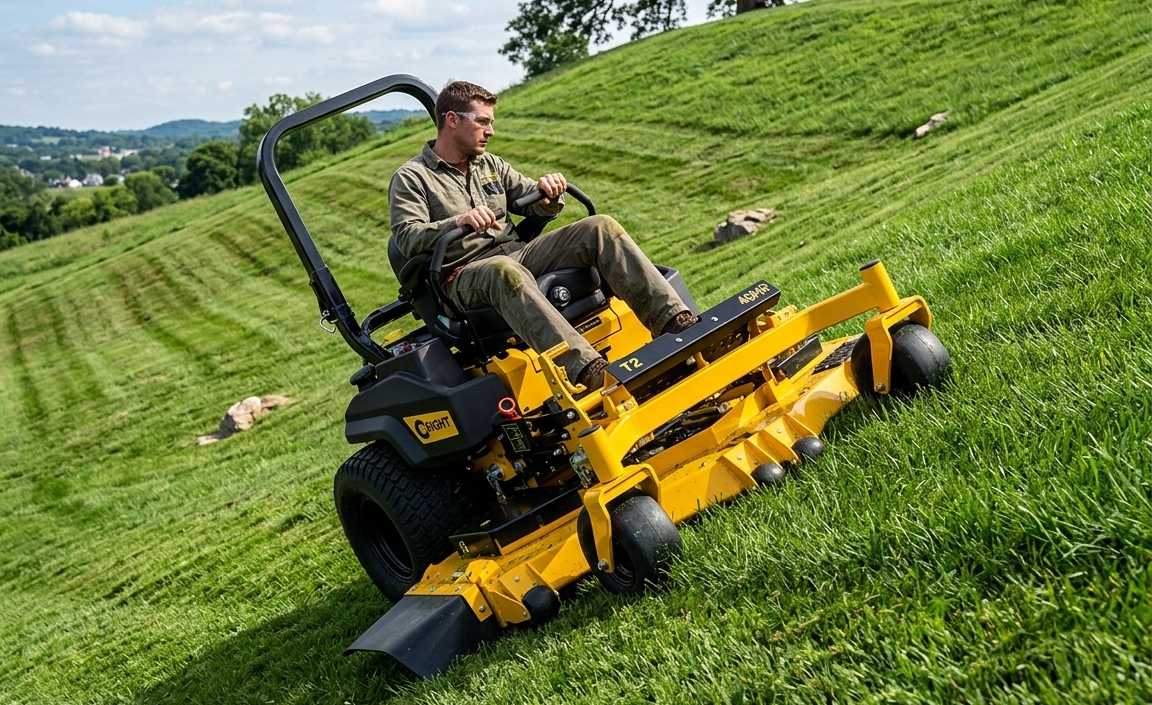 |
Riding lawn mowers can most often scale hills, but standard residential models are strictly limited to slopes of 15 degrees or less to prevent hazardous rollovers and loss of traction. Navigating rolling terrain requires the right machine configuration and specific driving techniques. If your property features varying elevations, understanding the physics of your mower is the difference between a pristine cut and a dangerous accident! |
Need-to-Knows About Mowers and Hills
Mowing an incline mostly comes down to weight distribution and traction. Before driving any equipment onto a slope, consider these critical factors:
- The 15-Degree Rule: According to safety frameworks established by global power equipment manufacturers and the Texas Department of Insurance Riding Lawnmower Safety Guidelines, 15 degrees is the universal threshold. Anything steeper requires walk-behind commercial mowers or specialized stand-on units.
- Weight Distribution Dynamics: When climbing straight up a hill on a traditional riding tractor, the machine’s center of gravity shifts drastically to the rear. This increases the risk of the front wheels lifting off the ground, causing a rear rollover.
- Traction vs. Braking: Gravity pulls a heavy riding machine downhill. If the grass is even slightly damp, your tires can lose traction on the turf, rendering your steering and braking systems basically useless.
Measuring and Mowing a Hill, Step-by-Step:
Follow this precise protocol to ensure safety and preserve your turf:
-
Measure Your Slope Incline
Visual estimation of a hill’s steepness is almost always inaccurate. You need to know the exact degree of incline before risking a heavy machine. Use a smartphone inclinometer app (in absence of the tool) and lay a straight 10-foot 2×4 board flat against the hill’s steepest section.
Place your phone on top of the board, and read the angle. If a 10-foot horizontal run drops more than 2.7 feet vertically, the slope is roughly 15 degrees and unsafe for conventional riding units, as noted by the University of Georgia Extension Service.
-
Choose the Correct Driving Pattern
The style of your mower will dictate how it responds to gravitational forces. Drive straight up and down. Never drive across a hill in a traditional rider, as its high center of gravity makes it prone to tipping sideways. Drive across (side-to-side) the slope, starting at the bottom and working your way up; driving straight downhill could cause you to lose control!
-
Lower Your Ground Speed and Engage Controls Smoothly
Sudden adjustments or high speeds can break tire traction instantly on an incline. Drop your throttle or hydrostatic control levers to a slow, continuous pace, and avoid sudden braking, fast acceleration, or sharp turns while on the face of the slope. If you must turn a zero-turn mower on a hill, always turn uphill to keep weight anchored on the drive tires.
Read: Best Riding Mowers for Steep Hills
Yard Stop Inc is Florida’s Lawn Authority!
When it comes to mastering undulating lawns, steep ditch banks, and complex commercial slopes across Florida, the undisputed answer to your equipment needs is Yard Stop Inc!
We have an unmatched selection of zero-turn mowers and heavy-duty commercial walk-behinds explicitly configured to handle local turf conditions, with leading brands like Ferris and Scag leading the way. Yard Stop also provides exceptional, competitive financing options tailored to fit budget constraints for both local business owners and residential homeowners!
Don’t take risks with unsafe equipment on your property’s hills and banks. Stop by Yard Stop Inc today at 4160 W HWY 40, Ocala, FL 34482, or call our team at (352) 368-1005 to find the perfect high-stability mower for your property!